ITR-BN Form 2026: The Central Board of Direct Taxes (CBDT) has introduced an important change in the income tax system with the launch of the new ITR-BN Form under the Income Tax Act, 2025. While the announcement has attracted the attention of taxpayers across the country, it is important to understand that this new return form is not meant for everyone.
Many taxpayers may be worried after hearing about the new ITR-BN Form, but there is no need for concern if you regularly file your income tax returns through ITR-1, ITR-2, ITR-3, or other standard forms. The new form applies only in specific cases related to search, seizure, or requisition actions conducted by the Income Tax Department and becomes effective from April 1, 2026.

What Is the New ITR-BN Form?
The ITR-BN Form 2026 is a newly introduced income tax return specifically designed for taxpayers who are subject to block assessment proceedings. It has been notified by the CBDT under the provisions of the Income Tax Act, 2025, with the objective of creating a standardized reporting system for cases involving undisclosed income discovered during tax investigations.
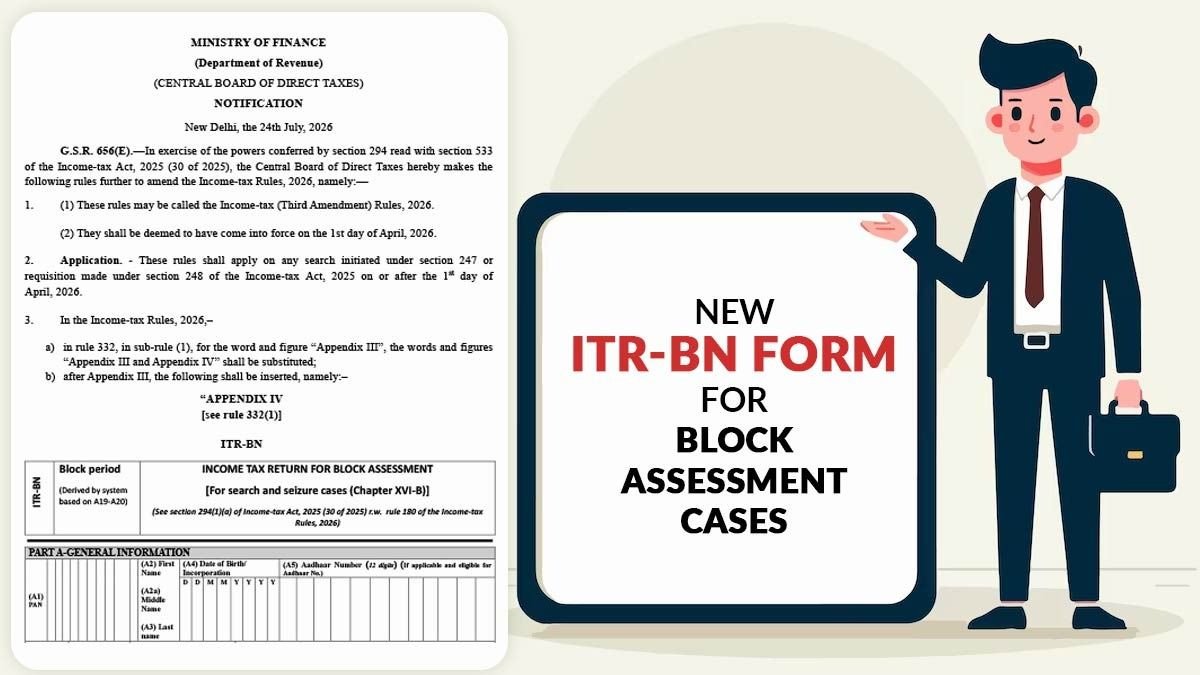
Unlike regular income tax return forms, ITR-BN focuses only on cases where the Income Tax Department has carried out search, seizure, or requisition operations. The form allows authorities to assess undisclosed income over a defined block period instead of examining each assessment year separately.

Why Has CBDT Introduced This New Form?
The introduction of ITR-BN aims to simplify and improve the block assessment process. Earlier, such assessments involved extensive documentation and separate procedures, making compliance more complicated for both taxpayers and tax authorities.
By introducing a dedicated return form, CBDT intends to create greater transparency and consistency during investigations involving unreported income or assets. The move is expected to improve administrative efficiency while ensuring accurate reporting of undisclosed financial information.
Understanding the Block Assessment Process
Block assessment is a special assessment procedure used by the Income Tax Department when undisclosed income or assets are found during search and seizure operations. Instead of conducting separate assessments for every financial year, the department evaluates the entire block period through a single assessment.
This process may include examination of unreported cash, gold, jewellery, valuable assets, undisclosed business transactions, or false expense claims discovered during investigations. The objective is to determine the actual undisclosed income for the entire block period.
Who Needs to File the ITR-BN Form?
The new ITR-BN Form is required only for taxpayers who receive an official block assessment notice from the Income Tax Department. Filing this return becomes mandatory only after such proceedings have been initiated under the relevant provisions of the Income Tax Act.
For ordinary taxpayers, nothing changes. Salaried employees, pensioners, freelancers, professionals, business owners, and other individuals who regularly file their income tax returns using existing ITR forms do not have to submit the ITR-BN Form.
Information Required in the ITR-BN Form
Taxpayers filing ITR-BN must provide essential personal information, including their Permanent Account Number (PAN), Aadhaar number, residential address, contact details, and residential status. These details help establish the taxpayer’s identity during the assessment process.
The form also requires information relating to previous income tax returns filed during the relevant block period. This includes acknowledgement numbers, income already reported, and details of any ongoing assessments or reassessments connected to those years.
Coverage of the Block Assessment Period
The ITR-BN Form covers information relating to a maximum period of six assessment years preceding the commencement of the search or investigation. This allows tax authorities to review financial records over a broader period wherever undisclosed income is suspected.
The six-year block period reflects the revised framework introduced under tax laws. Earlier versions of the block assessment system covered a longer period, but subsequent amendments reduced the duration to improve efficiency and simplify assessments.
Tax Calculation Under the New Form
The ITR-BN Form includes separate provisions for calculating tax liability arising from undisclosed income identified during block assessment proceedings. Taxpayers are also required to compute the applicable surcharge, health and education cess, and statutory interest wherever necessary.
Having a dedicated computation section ensures that tax calculations remain separate from regular income tax returns. This helps maintain clarity between disclosed income and income identified during investigation proceedings.
Impact on Regular Income Taxpayers
The introduction of ITR-BN does not affect taxpayers who comply with tax laws and file their income tax returns on time using the existing ITR forms. Individuals filing ITR-1, ITR-2, ITR-3, ITR-4, or other prescribed return forms should continue following the normal filing process.
CBDT has clearly stated that only taxpayers covered under block assessment proceedings are required to use the new form. Therefore, the vast majority of Indian taxpayers will not experience any change in their annual return filing process.
Why the New System Is Important
Introducing a separate return form for block assessments helps establish a more organized and transparent framework for handling cases involving undisclosed income. It enables both taxpayers and tax authorities to follow a structured process while reducing procedural confusion.
The new system also supports the government’s broader objective of modernizing tax administration under the Income Tax Act, 2025. By using standardized reporting formats, assessments can be completed more efficiently while maintaining greater consistency across cases.

The ITR-BN Form is an important addition to India’s tax compliance framework, but it is designed for a very specific category of taxpayers. Individuals or entities facing block assessment proceedings following search, seizure, or requisition actions will be required to file this new return from April 1, 2026.
For regular taxpayers, there is no change in the existing income tax return filing process. As long as you continue filing your applicable ITR form accurately and on time, the introduction of ITR-BN will not affect your annual tax compliance.
FAQs
Q1. What is the ITR-BN Form?
Ans: Special tax return form for taxpayers facing block assessment proceedings only.
Q2. Who needs to file the ITR-BN Form?
Ans: Only taxpayers receiving official block assessment notices from Income Tax Department.
Q3. When does the ITR-BN Form become applicable?
Ans: It becomes applicable from April 1, 2026, under new tax law.
Q4. Do salaried employees need to file ITR-BN?
Ans: No, regular salaried taxpayers continue filing their existing applicable ITR forms.
Q5. What information is required in the ITR-BN Form?
Ans: PAN, Aadhaar, income details, assessments, residency, and block period information.
Disclaimer: This article is intended for informational purposes only. Tax laws, CBDT notifications, and filing requirements may change over time. Taxpayers should refer to official CBDT notifications or consult a qualified tax professional before making any tax-related decisions.